Identify the land.
Screen Opportunity Zones against grid infrastructure, then verify parcels and local needs.
Grid capacity, parcel availability, and current zone eligibility require independent verification.
View location in Google Earth ↗619,651 estimated residents across 13 states and Washington, D.C. · 2020–2024 ACS five-year estimates.
Published secondary tables; direct Census reconciliation pending. Regional uncertainty has not been calculated. These are ancestry estimates, not registered participants or a 2026 headcount.
| Jurisdiction | Estimate | Regional share | Solar research |
|---|
The boundary layer uses generalized January 1, 2024 Census state geometry. It shows jurisdiction coverage only; it does not locate residents within a state or identify service areas. Counts must not be assigned to an Opportunity Zone, parcel, substation, SideKick point or SSR anchor.
SourceEnergy One also presents an illustrative 1,000-participant / 90-day planning scenario. No kickoff date, enrollment result, approved delivery commitment or private household record is imported here. Ancestry, birthplace and citizenship are different measures and must not be added.
Screening leads are not available properties or confirmed interconnection capacity. Source files date to 2020.
| Substation / ID | Location | Nearest OZ tract | Max. kV | Action | |
|---|---|---|---|---|---|
| Loading national source data… | |||||
Move from a grid lead to a verified parcel, a 5 MW project, and community ownership.
Explore the atlas, select a substation, and save it for parcel research.
Organization register and community localities · snapshot October 31, 2026.
| Location | Network / area | Map reference | what3words / SSR | Review |
|---|
The SideKick Working Warriors register contains 453 Jamaican localities and 13 proposed Northeast organising areas. The Northeast register also lists 14 state/DC coordination units; units without a locality entry are shown below.
Community source snapshot: SideKick location catalogues ↗. Community readiness is not assessed. The full organization intake snapshot contains 2,694 records across ten categories. Public-source names, geographic fields and provenance are included; private representative contacts and internal evidence are excluded.
Approximate populated-place references: GeoNames, CC BY 4.0. Only unique exact-name or alias matches within the recorded parish/state are mapped. No points are placed at guessed venues. Broad organising areas and ambiguous matches remain in the directory without markers.
Business points use source-supplied coordinates from Overture Maps Places and NCES IPEDS. Overture Maps Foundation attribution · Meta and Overture · CDLA Permissive 2.0. Presence in a public directory does not establish affiliation, ownership, current operations or service acceptance.
what3words lookup uses the existing SourceEnergy SSR resolver. Returned 3-meter squares identify source coordinates; approximate input locations remain approximate. Formal SSR/SourceCube binding status is tracked independently. No SideKick site has a verified SSR binding in this snapshot. Published SSR infrastructure anchors remain a separate map layer. Opportunity Zone screening applies to US solar research.
Communities that create value should own productive assets, steward them, and pass that wealth to future generations.
Screen Opportunity Zones against grid infrastructure, then verify parcels and local needs.
Confirm site control, interconnection, permitting, engineering, and the economics of a 5 MW plant.
Design the community trust, beneficiary rights, local participation, and revenue allocation.
Track ecological outcomes, local employment, maintenance, and long-term community benefit.
Document ownership and governance so productive assets can serve future generations.
The atlas supports research and project development. It does not execute property purchases, establish trusts, or certify Opportunity Zone tax eligibility.
Source provenance, screening assumptions, and the relationship to SourceCube and SSR.
8,764 Opportunity Zone features from 8764ozforWeb copy.kml and 75,328 substation records from Electric_Substations copy.kml.
Local files were verified against Dropbox’s block-content hashes. The client-modified dates are September 2020; Dropbox upload dates in 2026 do not establish current source data.
Coverage reflects the supplied files, including territories. Source ID 306773 appears at two distinct Texas locations; both records are retained with unique internal keys pending reconciliation. Counts do not certify completeness or current designation.
Each substation is compared with original zone polygons, including interior holes and multi-part boundaries. Inside a zone: 0 miles. Outside: distance to the nearest zone surface.
The national calculation uses a local WGS84 azimuthal equidistant projection per zone and a 20 statute mile search limit. Distances are approximate screening distances, not surveyed routes. Generalized map boundaries do not drive the national calculation.
Uploaded analytical layers use spherical geodesic calculations in the browser. Only the nearest zone per substation is reported; one lead may be near several zones.
SourceCube provides orchestration and intelligence. SSR retains canonical spatial identity; its public, read-only registry is connected as a separate optional map layer.
Opportunity Zones, substations, and parcel research remain external evidence until a reviewed integration assigns governed identities. No canonical anchor identities are fabricated.
Development drafts currently stay in this browser. The existing Revolution Wealth fund, vehicle, project, and asset registries are the intended operational integration targets.
Checking…
Current zone designation; parcel boundaries, title, ownership, price, usable area, access, zoning, slope, wetlands, flood exposure, and solar resource.
Utility hosting capacity, queue status, connection cost, protection requirements, export limits, and project AC/DC design. A reported voltage is not available MW capacity.
Trust structure, beneficiary governance, financing, offtake, permitting, and tax treatment need project-specific review before commitment.
Source-backed sale leads for proposed 5 MW community solar projects. Sponsor: SourceEnergy Capital.
From extraction to ownership. From exclusion to enterprise. From survival to sovereignty.
“I was given the mantle to finish the work.”
African labor, land, knowledge and enterprise helped build extraordinary wealth. Our story asks who owned the land, who controlled the capital, and who passed the returns to the next generation. Reclaiming legacy means turning contribution into ownership, control and intergenerational abundance.
Revolution Wealth carries that purpose into land, clean energy, community trusts and productive enterprise. The work is to build institutions and assets that outlive us.
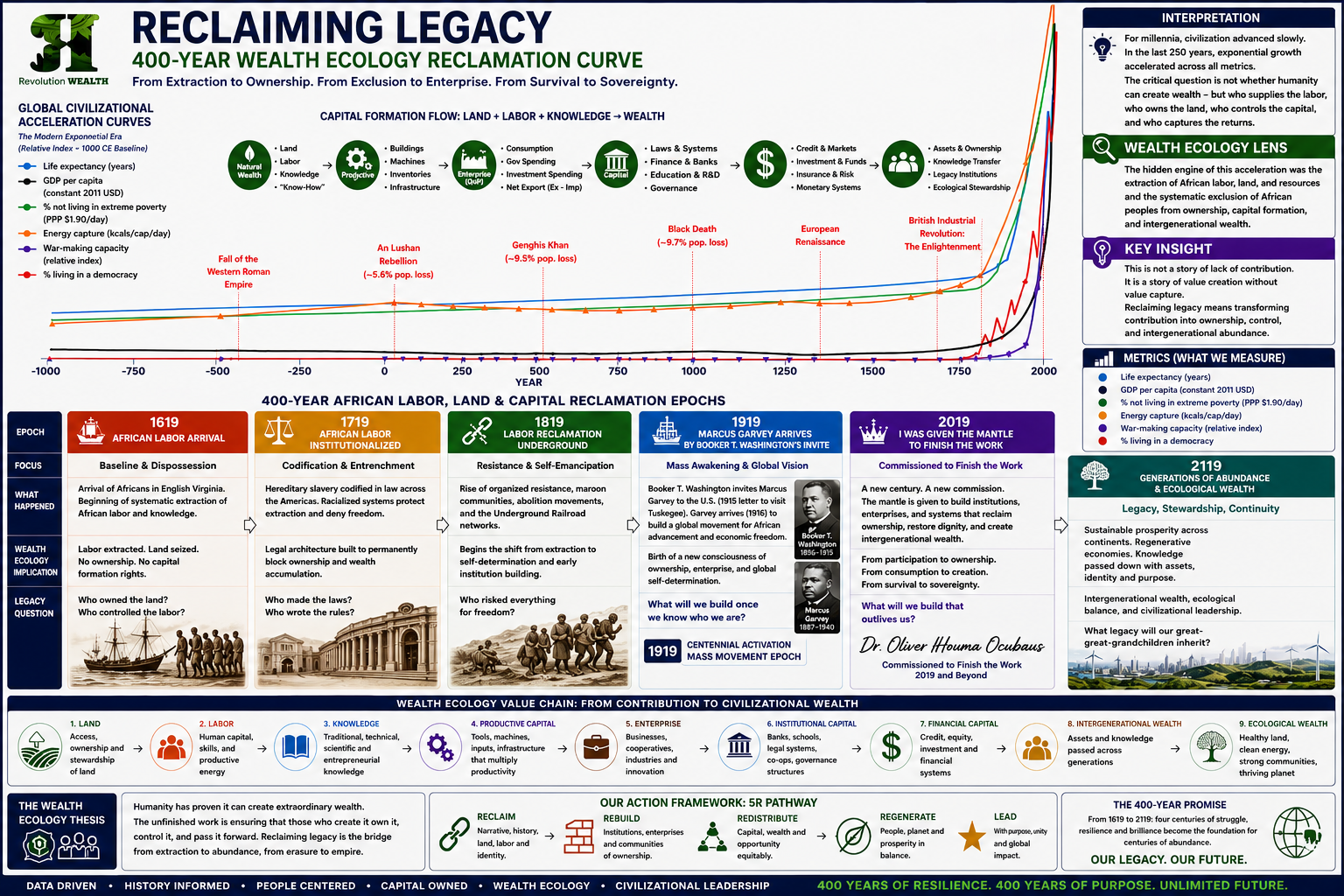
The centennial chapters below follow the framework in our original graphic. They connect a historical legacy to a personal commitment and a future vision.
The arrival of enslaved Africans at Point Comfort, Virginia, anchors this story of labor, knowledge and wealth creation under coercion. Contribution did not carry an equal right to ownership or to the wealth it produced.
This centennial chapter represents the legal and institutional entrenchment of hereditary slavery and exclusion from ownership. It asks us to examine how institutions determine who can accumulate capital and pass it forward.
This chapter honors resistance, maroon communities, abolition and the freedom networks of the nineteenth century. It marks the pursuit of self-determination and the work of building institutions that could sustain it.
Booker T. Washington’s emphasis on education and enterprise, and Marcus Garvey’s vision of African advancement and economic freedom, inform this chapter. The 1919 marker represents a centennial movement epoch; Garvey arrived in the United States in 1916.
In the founder’s account, 2019 marks a new commission: build institutions, enterprises and systems that reclaim ownership, restore dignity and create intergenerational wealth. This is the commitment behind Revolution Wealth.
From participation to ownership. From consumption to creation. From survival to sovereignty.
What will we build that outlives us?A long-term vision of assets and knowledge passed forward, regenerative economies, healthy land and resilient communities. The 2219 chapter expresses an aspiration for future generations.
What legacy will our great-great-grandchildren inherit?Land → Labor → Knowledge → Productive capital → Enterprise → Institutional capital → Financial capital → Intergenerational wealth → Ecological wealth.
Our proposed 5 MW solar projects connect land and energy infrastructure with a project-level ownership goal: 50% community trust / 50% investors. Site control, interconnection, contracts, financing and trust governance turn that purpose into a deliverable project.
Reclaim. Rebuild. Redistribute. Regenerate. Lead.
The graphic preserves the founder’s original vision. Its centennial dates organize a reclamation framework; they do not date the beginning of every institution or movement described. The global curves are illustrative and are not a sourced statistical dataset. The 2019 commission is a personal account; 2219 is a future vision.
Historical context: National Park Service: the 1619 arrival; PBS American Experience: Marcus Garvey.
Published stories, campaign materials and a route for new community stories.
The founding story of Revolution Wealth: the legacy of contribution, a personal commission in 2019, and the work of building community ownership for future generations.
SourceEnergy Media · SourceEnergy One
Read Our History →A four-page kit with the campaign overview, original graphic, launch announcement, social posts and an email draft.
Campaign copy is prepared for distribution. No email or social post is sent automatically.
Subscribe or import these feeds into SourceEnergy Media and SourceEnergy One. Both start with the story just published here.
These feeds are published by Revolution Wealth. Automatic display on the two external platforms is not connected yet.
Share a community ownership story, project update or lesson from the work. Choose the intended channel and prepare an email to the editorial contact at SourceEnergy Capital.
This form opens your email application with the submission filled in. You review and send it. Nothing is submitted by this website, and submitted stories require editorial review before publication.
Fields stay in this tab only. You can download a copy before leaving. Include links to material you have permission to share; avoid private records and identifying details without consent.
Develop a buyer pathway for each candidate project. Sponsor: SourceEnergy Capital.
The public procurement page provides a CE-8 PPA registration route for Virginia / North Carolina projects. Check current solicitation materials, size thresholds, delivery requirements, deadlines and eligibility before submission.
Official PPA procurement page ↗Registration and executed confidentiality documents may be required. No bid has been submitted.
Utility RFP: qualify the plant and delivery location against a named solicitation.
Corporate PPA: establish buyer load or financial hedge needs, market access, settlement basis and credit.
Shared solar: evaluate the applicable state program and subscriber structure independently of a utility PPA.
Virginia’s published third-party pilot summary describes eligible facilities of 50 kW–3 MW. A 5 MW project should not be assumed eligible for that pilot.
Virginia SCC pilot information ↗Confirm the project seller and authorized signer, site control, interconnection pathway, energy forecast, buyer and credit support, delivery point, price and escalator, tenor, RECs, curtailment, milestones, defaults and lender rights.
This workbench produces a discussion record, not an executable power contract.
A place-based approach to strengthening households and building lasting community wealth by coordinating housing and community assets, resilient energy, education, local enterprise, and accountable investment under a clear stewardship framework.
Begin with one verified community property, an accountable operator and households that choose to participate. Multifamily housing is the first application; school-linked communities and diaspora–Jamaica programmes can adapt the same approach to their own needs.
Assess efficiency, solar, storage and backup for essential services. Size each system from actual site conditions and critical loads.
Use the atlas for public geographic evidence and SourceEnergy One for authorized private participation. Keep planning drafts and operating records distinct.
Connect resident voice, housing stewardship, family support and local enterprise through accountable operators and agreed service roles.
Offer voluntary financial capability, workforce development, mentoring and practical energy or technology learning.
Capital and governance support all four pillars. Define the asset owner, operator, resident representation, responsibilities, budget and community benefits before making commitments.
A Community Access Point is an on-site delivery hub. Count it as operational only after its location, operator, services and readiness are verified.
Measure homes improved, consenting households served, learning and employment outcomes, energy costs, generation and tested backup duration. Distinguish operating receipts and expenses from grants, borrowing, capital commitments and distributions. Missing outcomes remain unknown.
Outage protection requires an appropriately designed solar-plus-storage system and islanding controls; nearby infrastructure or a solar capacity target alone does not establish resilience. DOE solar and resilience guidance ↗
Each destination retains its own permissions, consent and review. Registration, tenancy, programme participation, trust membership and investment participation are separate decisions.
This is a proposed framework, not an operating-site register, established fund or investment offer. A housing property, household trust, service operator and energy-project vehicle have different roles. The solar project’s proposed 50/50 ownership and 5 MW target below do not automatically apply to housing ownership or every community site. Housing and essential support must not depend on adopting a spiritual interpretation or joining a financial arrangement.
Begin with SourceEnergy One. Connect with Revolution Wealth to explore community ownership, then request an introduction to SourceEnergy Wealth Advisors for the next planning conversation.
Your starting point for the SourceEnergy ecosystem. Register or sign in, then return here to discuss your community and participation interests.
Register / sign in to SourceEnergy One ↗Already registered? Continue to Revolution Wealth.
Introduce your community, potential site or partnership. Discuss the proposed community trust role in a solar project and the steps needed to establish its ownership.
Request a handoff for a conversation about financial education, trust and legacy planning, and the stewardship of community wealth.
Interest and handoff links prepare an email for you to review and send. We will agree what information may be shared before an advisor introduction. Registration does not create a trust interest or an advisory relationship; separate review and agreements apply.
The proposed ownership target applies to each solar project. It does not assign 50% of the fund itself to the community.
Ownership target confirmed by the sponsor’s instruction. Trust establishment, capital contributions, voting rights, cash distributions, tax allocations and transfer restrictions require definitive documents.
The investor-side legal holding route—directly or through a qualifying fund/business interest—remains subject to structuring. No entity or ownership interest has been created by this diagram.
A 50% ownership stake does not automatically mean 50% of capital contributions, votes, tax credits or cash distributions. Those terms remain open.
Fund certification requires an eligible entity and tax filings; a map label does not establish QOF status.
IRS fund certification requirements ↗SourceEnergy Capital is developing a community solar ownership model and preparing project diligence. Investment amount, investor eligibility, returns, offering terms and subscription documents are not set.
Investor interest conversations are open; offering and subscription launch remain pending. Confirm the legal issuer, offering pathway, approved materials and intended recipients before invitations are issued. There is no payment or subscription flow on this site.
The brief explains the proposed ownership model. It is not an investment offer or executed term sheet.
SEC offering pathways ↗Saved leads are proposed pipeline entries. They are not acquisitions, fund contributions, trust assets or securities subscriptions.